If you are a local business owner or service provider in 2025, your visibility online directly determines how many new customers choose you over your competitors.
Here are some of the Google Local SEO statistics in 2025:
- 46% of Google searches have local intent
- 76% of consumers searching for “near me” visit the business within a day
- 88% of individuals using a smartphone for a local search visit a related store within a week
The data shows how you capture active customers if your services are visible locally. Now the question is, can you really stay ahead in 2025 without a clear local SEO checklist to guide your visibility and growth?
If you have similar concerns, you have landed on the right page. In this blog I have gathered together a simple yet most effective local SEO checklist for 2025, designed to help you strengthen your local presence step by step.
- Claim & verify Google Business Profile
- Local Keyword Research
- On-Page SEO & Website Optimization
- Local Landing Pages / Location Pages
- Citation / NAP Consistency
- Google Reviews & Reputation
- Local Link Building & Off-Page
- Local Content Strategy
- Monitoring & Reporting Checklist
- Technical / Advanced SEO Checklist (Local)
Instead of flipping through directories or relying only on word-of-mouth, now people simply open Google, type in what they need, and make decisions fast. So, it’s really important that you make strategic & timely decisions.
Download Your Free Local SEO Checklist Here
1. Claim & Verify Google Business Profile

Your Google Business Profile (GBP) is the cornerstone of local SEO in 2025 that puts your business on the map. In many cases, it’s the first thing nearby customers see when they search for services similar to yours.
Steps to Claim & Verify your Google Business Profile
- Start by claiming your Google Business Profile for every physical location you operate.
- Enter your legal business name exactly as it appears offline. Avoid adding extra keywords; Google might flag it as spammy.
- After claiming, Google may ask for verification through postcard, phone, or video. Follow the instructions carefully.
- Once verified, complete every part of your profile like business hours, holiday hours, and other details.
- Choose both primary and secondary categories that best match your actual services.
- Add photos and try to include your storefront, interior, team, and examples of your work.
- Turn on messaging so customers can reach you directly. If your business accepts appointments, connect a booking link.
- Include a few common customer questions with clear, informative answers.
Once your profile is live, keep an eye on your Google Business Profile Insights and actively check how many searches, calls, direction requests, and photo views you’re getting.
These numbers show how people find and engage with your business and help you detect what’s working and areas of improvement.
2. Local Keyword Research

Local searches sound very different from usual ones. When people look for services nearby, they tend to use everyday phrases. For example, neighborhood names, city landmarks, or modifiers like “open now,” or “near me.”
Understanding these patterns helps you align your strategy with what real customers are typing into Google. To win local SEO, you need to build a seed list of keywords around your services and pair each one with your city or neighborhood names.
For example, instead of targeting a broad phrase like “best digital marketing agency,” go for something more localized, such as “best digital marketing agency in Uttara.” These phrases attract users in your service area and make your business more visible in local results.
Next, analyze how different keywords behave in Google search. Some terms trigger the local map pack and show nearby agencies with Google Business Profiles. Others show regular organic listings.
So consider including long-tail keywords that reveal strong user intent. Phrases like “affordable SEO services for small businesses in Uttara” or “Google Ads specialist near me for my clothing business” tend to convert better. Because they reflect clear user needs and immediate action.
Once you’ve collected enough keywords, organize them by intent. Transactional keywords like “hire,” “consult,” or “book” should guide your service or contact pages. Discovery-focused keywords, like “top digital marketing agencies in Dhaka,” work well for list-style or comparison pages that help people explore options.
Finally, review your keyword data regularly to see which phrases drive inquiries, messages, or calls through your Google Business Profile. Keep updating your content to reflect those evolving patterns.
3. On-Page SEO and Website Optimization

Your website needs to load fast and clearly show local signals that help both search engines and customers trust you. To ensure it, start with some basic steps, like:
- Make your phone number and email address clickable.
- Place your Name, Address, and Phone (NAP) details clearly in the contact page.
- Monitor your Core Web Vitals to ensure pages meet Google’s experience standards.
- Use short but insightful titles and meta descriptions.
- Avoid using the same content in multiple pages.
- Add local proof such as community mentions, recent projects, testimonials, or awards.
Beyond these basics, you also need to pay close attention to site speed and mobile usability. It’s an unskippable part because 53% of users abandon mobile websites that take more than 3 seconds to load, and 79% are unlikely to return after a slow experience.
So, work on improving performance by compressing images, minifying code, enabling browser caching, and making sure your mobile experience is smooth. When visitors arrive and your site loads quickly with relevant local content, your chances of converting increase.
4. Local Landing Pages & Location Pages
The main purpose of the location page is to turn local searchers’ curiosity into real action. When someone in your area searches for the service you offer, they want to see something that feels close, familiar, and trustworthy.
To earn that trust, you need to combine the location page with a headline that connects your service and place.
Such as “The Best Software Solution Provider Company in Uttara.” Then follow it with a short description like, “We help Uttara-based businesses grow faster with personalised software solutions that boost efficiency and customer satisfaction.”
This structure instantly tells visitors what you offer, where you are based, and also with Google local ranking. It is recommended to keep location-specific content and service area pages that feel natural but informative.
To make it more strategic, include customer testimonials, FAQs, and a strong call to action like “Book a Free Strategy Session.”
But avoid mass-producing thin city pages that only swap out the place name. Instead, focus on quality over quantity and build out new pages only when you have something genuinely local to say. That approach helps your site rank better and earns real trust from nearby customers.
5. Citation and NAP Consistency

Citations and NAP consistency might sound technical, but they’re actually the backbone of local SEO trust.
Citations are your business listings across the web like, on Google, Yelp, Bing, Facebook, local directories, and industry-specific sites.
Each time your Name, Address, and Phone number (NAP) appear consistently, it reinforces your legitimacy in the eyes of both search engines and customers.
To maintain it, first you need to create a master citation sheet or keep everything organised. Then list every platform where your business appears. Note the exact business name, address, phone number, and link to the listing. Mark, if each listing is claimed and verified.
Next, audit your citations on top sources such as Google, Apple Maps, Yelp, Bing Places, and data aggregators like Neustar Localeze or Foursquare. Update any mismatched or outdated details.
Even a simple detail like “St.” versus “Street” can cause search engines to treat listings as different entities.
It’s proven that 62% of consumers lose trust in a business if they find inconsistent contact information. That’s why reviewing and cleaning your listings is not an option; it’s a must.
A consistent citation profile strengthens your credibility, supports your Google Business Profile ranking, and ensures customers can find you with confidence.
6. Google Reviews and Reputation

To understand it thoroughly and in simple terms, consider your own perspective while researching a product or service. Would you choose a business with poor reviews over one with strong ratings? You definitely wouldn’t.
In fact, 91% of consumers use reviews to evaluate local businesses, and 65% are more likely to choose a business that actively responds to reviews. Businesses with 50 + reviews and 4.5+ star ratings usually see up to 30% higher visibility in local search results.
To make reviews work for you, build a simple review funnel that feels genuine. After you’ve delivered a good experience, personally ask your customers to share their thoughts. Most happy customers will accept, so follow up later with a short, friendly message that includes a one-click review link they can use in seconds.
When new reviews come in, don’t stay silent. Take a moment to thank each positive reviewer. For the rare negative ones, reply with empathy and show that you care about fixing the issue.
Aim for steady, consistent growth in reviews rather than short bursts. Track metrics like average rating and response time to improve your strategy.
Authentic, well-managed reviews boost both your local SEO and your reputation, helping new customers confidently choose your business.
7. Local Link Building & Off-page Signals
To give your business real local authority, you need more than a great website; you also need meaningful recognition in your community. In this case, local links and mentions send search engines a clear message that you are relevant in this place.
Few local link-building tactics:
- Building genuine connections with nearby businesses and community groups that lead to organic mentions and backlinks.
- Getting involved in local events, sponsorships, or fundraisers so people, community spaces, and websites talk about you.
- Writing short guest posts or giving quotes to local blogs, schools, or news outlets.
- Creating something people want to reference. For example, a local area guide, an event calendar, or resource pages,
- Watching out for unlinked mentions and reaching out with a polite note asking them to add the link.
Always focus on relevance, not volume. A handful of quality links from well-known local sites will surely outperform many low-value directory links.
When your business is mentioned by respected peers, your visibility improves, your credibility grows, and your local SEO strengthens naturally.
8. Local Content Strategy
To build a strong local content strategy, you must create resources that resonate with your community and reflect real-world needs. It’s proven that customizing your content for a specific location improves both visibility in local search and relevance to users.
To win it, you can begin by telling real stories about your work in the community and share how you helped a nearby client solve a problem or improve something they care about.
Next, create useful guides that speak directly to your area. For example, you could write about “how small businesses in Gulshan can attract local foot traffic” or “easy home service tips for families in Dhanmondi.” When your content sounds familiar and relevant, people naturally stay longer and trust your expertise.
One strategic move here is to answer the questions people in your community keep asking. Then, share your content across your Google Business Profile and social platforms to reach more people without extra effort.
Finally, review your progress through Google Search Console and GBP Insights. Notice which topics get the most clicks or calls, and create more content around those themes. When your content feels genuinely useful and community-driven, it not only earns trust but also helps your business rank higher in local searches.
9. Monitoring & Reporting Checklist
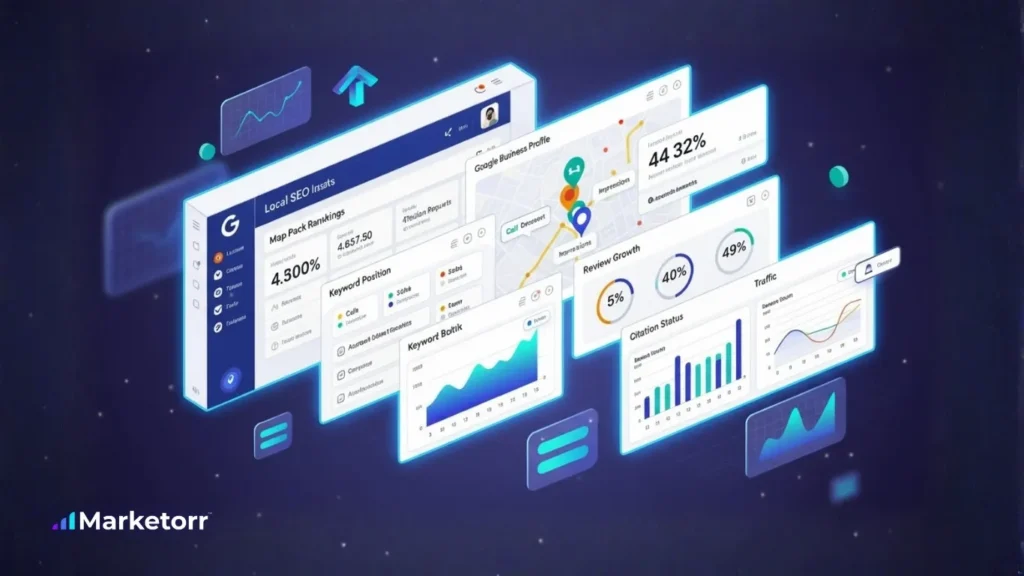
Strong local SEO performance depends on consistent monitoring, not random guesses. So, consider your tracking system as your business compass. It shows where you stand and where to improve.
Once you’ve confirmed the previous steps, move on to the next ones –
- Connect your Google Business Profile data (calls, direction requests & messages) with website analytics to see the Customer journey.
- Use Google Search Console to understand which keywords attract local searches and how your pages rank in different areas.
- Check your map pack rankings and keep tabs on your review growth and citation consistency each month.
- Visualize everything in a clear dashboard that highlights impressions, clicks, and conversions by location.
- Schedule a short quarterly audit to catch technical issues early.
Over time, these are the insights that reveal what truly drives local engagement and help you make smarter, data-driven decisions.
10. Technical & Advanced Local SEO
A strong local SEO strategy starts with a solid technical foundation. As your business keeps expanding, it adds new locations and pages to its websites. In that case, technical & advanced SEO makes sure that your website is fast, scalable, and easy for search engines to understand.
You need to use structured data to clearly communicate your business information. For example, your address, phone number, hours, and service areas to search engines. Apply schema markup to every location page and test it regularly to confirm accuracy.
Make sure your canonical tags identify the primary version of each page, and manage your sitemap & robots.txt file to guide search crawlers efficiently. If your website targets multiple languages, set up proper hreflang signals and language-specific URLs.
For service-area businesses, use Google’s service area feature rather than listing fake addresses. This authentic approach, supported by strong GBP signals and well-optimized local pages, builds lasting trust and visibility.
You’ve Got the Roadmap, Now Let Marketorr Help You Reach the Finish Line!
Now you’re aware of what drives actual results with the complete checklist. Your Business Profile is set, your NAP information is clean, and your reviews are growing. It’s time to keep the momentum growing!
Local SEO is not a one-time fix. At Marketorr, we not only guide you through the checklist, but we also help you turn every move into measurable outcomes.
Be it optimizing your location pages or building high-quality backlinks, our professional team focuses on everything that moves the needle for your business.
So, ready to grow fast and show up where your customers are looking for you?
Let Marketorr handle the heavy lifting while you focus on serving your customers!